← All ways to play9 complete adventures
Evidence cross-check mysteries
Which record agrees with every clue?
Turn separate observations into one defensible decision. Players compare records, record what each clue establishes, and check the final candidates against the full set of evidence.
A good choice for your group
Choose this when your group enjoys noticing differences, explaining a choice and ruling out tempting near matches.
The players’ job
Keep the badge results beside the candidate sheet. For each candidate, point to the evidence that supports or rejects it; the final choice must pass every printed check.
How the reasoning works
Collect independent evidence
Read each clue’s target before comparing the figures or records. Write a result beside its badge so evidence from different pages stays distinct.
Test the candidates
Compare each required field with the matching clue result. A convincing first match is only a starting point; work across the remaining checks.
Defend the decision
Name the candidate that passes all the rules and use its printed finishing instruction. Be ready to show which check rejects another candidate.
If the result does not fit
If more than one candidate still seems possible, check whether every required evidence field has been used. If none survives, return to the first uncertain badge result.
For the host: Ask “Which printed check rules that one out?” before opening a hint. This helps the group show its reasoning without giving away the successful record.
Choose a mission
Each adventure has its own evidence, story and final instructions. Open a game to check its full setup and print plan.
A complete player preview
Museum Shadow Case
Welcome to the shadow puppet museum. A frame was moved during a projection test; the first room note describes the rehearsal, not the later move. Your team has the original records on the table. First recover five pieces of information, then use the final plan to locate the puppet frame. Keep every result beside its badge so another teammate can check your reasoning.
Read every clue below, including the final instructions. Answers and host hints stay in the host materials.
Clue 1 of 6
Record
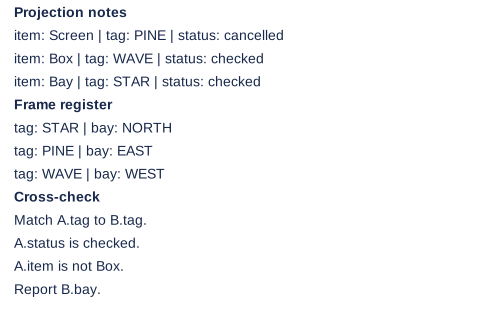
Use the projection notes and frame register to follow the completed record. Match printed keys, then report the requested field. A planned or cancelled entry cannot prove a move.
Read this clue in text
Projection notes
item: Screen | tag: PINE | status: cancelled
item: Box | tag: WAVE | status: checked
item: Bay | tag: STAR | status: checked
Frame register
tag: STAR | bay: NORTH
tag: PINE | bay: EAST
tag: WAVE | bay: WEST
Cross-check
Match A.tag to B.tag.
A.status is checked.
A.item is not Box.
Report B.bay.
Clue 2 of 6
Order
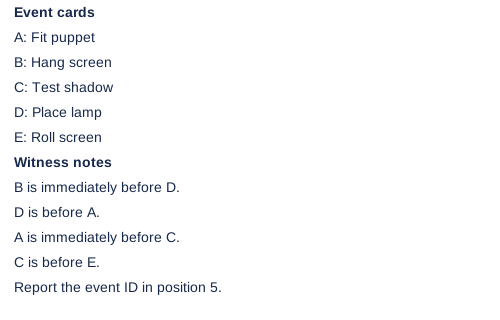
Arrange the four event cards using every witness note. "Immediately before" means there is no event between them. Report the requested position after the whole order has been checked.
Read this clue in text
Event cards
A: Fit puppet
B: Hang screen
C: Test shadow
D: Place lamp
E: Roll screen
Witness notes
B is immediately before D.
D is before A.
A is immediately before C.
C is before E.
Report the event ID in position 5.
Clue 3 of 6
Signal
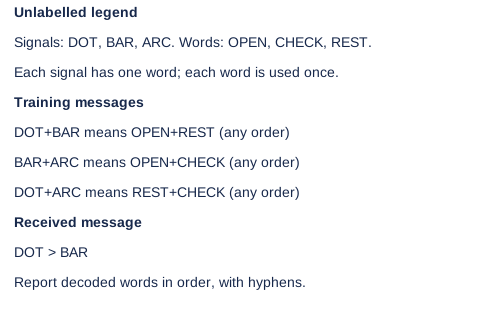
Each signal means one different word. Use the training examples to recover the legend. Words marked "any order" may be swapped; compare shared signals across cards. Decode the received message from left to right. The desk uses this message when handling a missing puppet frame.
Read this clue in text
Unlabelled legend
Signals: DOT, BAR, ARC. Words: OPEN, CHECK, REST.
Each signal has one word; each word is used once.
Training messages
DOT+BAR means OPEN+REST (any order)
BAR+ARC means OPEN+CHECK (any order)
DOT+ARC means REST+CHECK (any order)
Received message
DOT > BAR
Report decoded words in order, with hyphens.
Clue 4 of 6
Kit
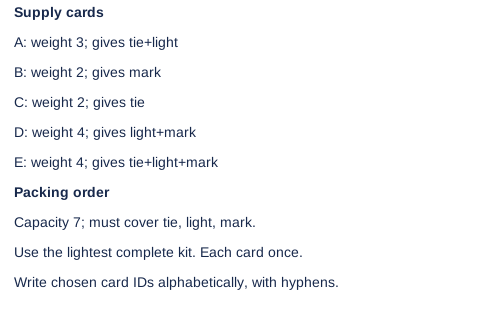
Pack a kit that supplies all three needs. One card may cover two needs, but its weight is counted once. Choose the lightest complete kit within the carrier limit. Report its card letters alphabetically.
Read this clue in text
Supply cards
A: weight 3; gives tie+light
B: weight 2; gives mark
C: weight 2; gives tie
D: weight 4; gives light+mark
E: weight 4; gives tie+light+mark
Packing order
Capacity 7; must cover tie, light, mark.
Use the lightest complete kit. Each card once.
Write chosen card IDs alphabetically, with hyphens.
Clue 5 of 6
Habitat
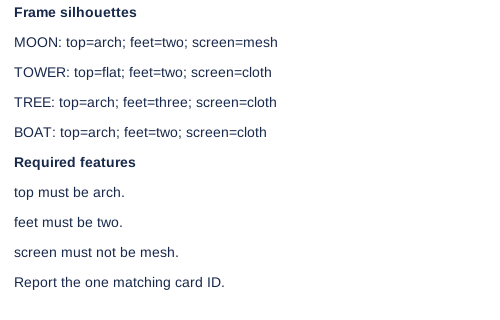
A rehearsal sketch records the frame top, feet and screen. Compare the silhouette cards and identify the frame that fits the whole sketch.
Read this clue in text
Frame silhouettes
MOON: top=arch; feet=two; screen=mesh
TOWER: top=flat; feet=two; screen=cloth
TREE: top=arch; feet=three; screen=cloth
BOAT: top=arch; feet=two; screen=cloth
Required features
top must be arch.
feet must be two.
screen must not be mesh.
Report the one matching card ID.
Clue 6 of 6
Final
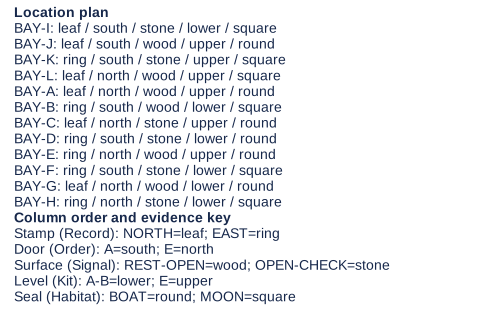
Use each recorded result in the evidence key to learn one feature. Compare all five features with the location plan. Report the one location ID supported by every source, then explain why a nearby alternative fails.
Read this clue in text
Location plan
BAY-I: leaf / south / stone / lower / square
BAY-J: leaf / south / wood / upper / round
BAY-K: ring / south / stone / upper / square
BAY-L: leaf / north / wood / upper / square
BAY-A: leaf / north / wood / upper / round
BAY-B: ring / south / wood / lower / square
BAY-C: leaf / north / stone / upper / round
BAY-D: ring / south / stone / lower / round
BAY-E: ring / north / wood / upper / round
BAY-F: ring / south / stone / lower / square
BAY-G: leaf / north / wood / lower / round
BAY-H: ring / north / stone / lower / square
Column order and evidence key
Stamp (Record): NORTH=leaf; EAST=ring
Door (Order): A=south; E=north
Surface (Signal): REST-OPEN=wood; OPEN-CHECK=stone
Level (Kit): A-B=lower; E=upper
Seal (Habitat): BOAT=round; MOON=square
Start after: Record, Order, Signal, Kit, Habitat
All 9 games in this collection
Cross-check evidenceAges 8–10 · Est. 35–50 min
Six storage bays look almost right; each wrong bay conflicts with a different record. Work together to locate the model moon.
6 clues · 2–6 players · No cutting
See clues & prepare → 
Cross-check evidenceAges 8–10 · Est. 35–50 min
A parcel changed desks twice and its first shelf label is no longer current. Work together to locate the returned story parcel.
6 clues · 2–6 players · No cutting
See clues & prepare → 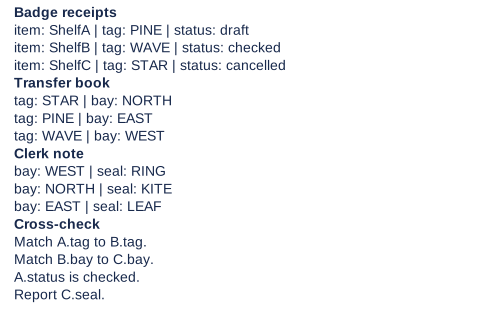
Cross-check evidenceAges 8–10 · Est. 35–50 min
A moved badge box left a checked receipt, an old tag and a cancelled transfer. Work together to prove where the badge box belongs.
6 clues · 2–6 players · No cutting
See clues & prepare → 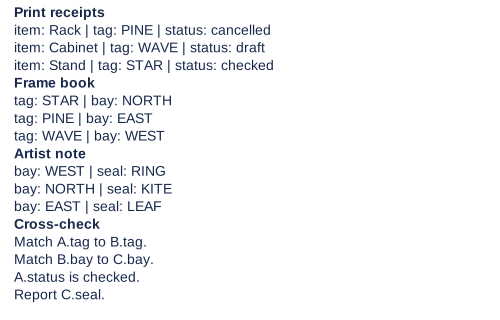
Cross-check evidenceAges 8–10 · Est. 35–50 min
Storage labels use shapes and words, so the case can be solved on a black-and-white printout. Work together to locate the shape-print exhibit.
6 clues · 2–6 players · No cutting
See clues & prepare → 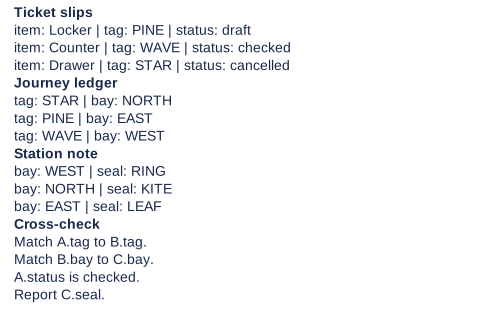
Cross-check evidenceAges 8–10 · Est. 35–50 min
The first ticket record was cancelled; a later checked record tells the useful story. Work together to locate the lost ticket.
6 clues · 2–6 players · No cutting
See clues & prepare → 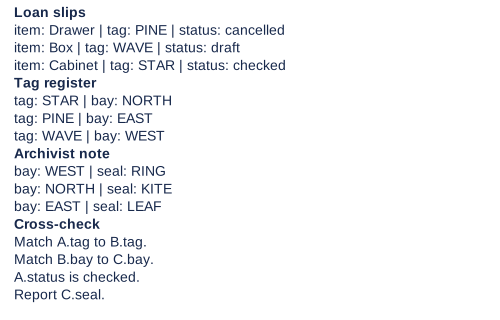
Cross-check evidenceAges 8–10 · Est. 35–50 min
The stamp was borrowed under a tag number rather than the name on its storage drawer. Work together to find the borrowed archive stamp.
6 clues · 2–6 players · No cutting
See clues & prepare → 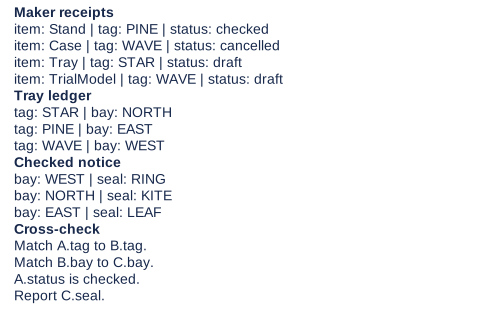
Cross-check evidenceAges 8–10 · Est. 35–50 min
A maker lent a model under a symbol tag; the delivery desk recorded only the matching tray. Work together to find the missing maker label.
6 clues · 2–6 players · No cutting
See clues & prepare → 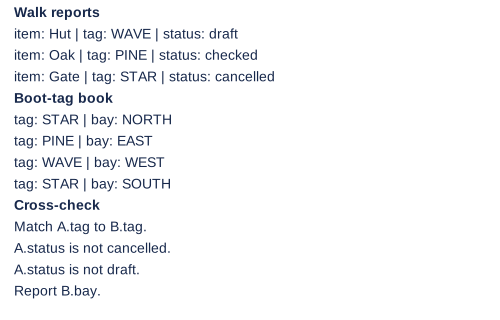
Cross-check evidenceAges 8–10 · Est. 35–50 min
Rain smeared a path sign, and a cancelled walk must be separated from the walk that happened. Work together to trace the waterproof message pouch.
6 clues · 2–6 players · No cutting
See clues & prepare → Cross-check evidenceAges 8–10 · Est. 35–50 min
A frame was moved during a projection test; the first room note describes the rehearsal, not the later move. Work together to locate the puppet frame.
6 clues · 2–6 players · No cutting
See clues & prepare → Try a different reasoning task next
Choose this when children like maps, tracing alternatives and working out why a possible-looking journey will or will not work.
Plan a resource route →