← All ways to play9 complete adventures
Ecology and habitat mysteries
Which five habitat choices work together?
These imaginary field desks make relationships visible. Players use fictional classification, food-web observations and resource needs to design a five-part habitat.
A good choice for your group
Choose this when your group likes thinking about how one choice affects another and can explain a chain of relationships.
The players’ job
Use the game’s printed relationship rules. Keep each clue result with its label, then check how the chosen elements fit together on the final sheet.
How the reasoning works
Read the relationship key
Find what each link or condition means. The fictional scenario supplies the facts needed for play; remembered facts about real animals are not required.
Connect the evidence
Record which conditions each clue establishes. When you try a choice, check its effects on the other required parts of the habitat.
Check the whole system
Confirm every printed requirement, then use the final sheet’s instruction to identify the successful outcome.
If the result does not fit
Checking one appealing species or location is not enough. Trace its required relationships and confirm that the rest of the proposed solution still works.
For the host: Ask “What else needs to be true if we choose this?” Keep the discussion tied to the facts on the sheet.
Choose a mission
Each adventure has its own evidence, story and final instructions. Open a game to check its full setup and print plan.
A complete player preview
Canopy Nest Build
Welcome to the fictional canopy survey. The nest must match a linked food web and provide five different parts without cutting any paper. Your team has the original records on the table. First recover five pieces of information, then use the final plan to assemble the canopy nest model. Keep every result beside its badge so another teammate can check your reasoning.
Read every clue below, including the final instructions. Answers and host hints stay in the host materials.
Clue 1 of 6
Food
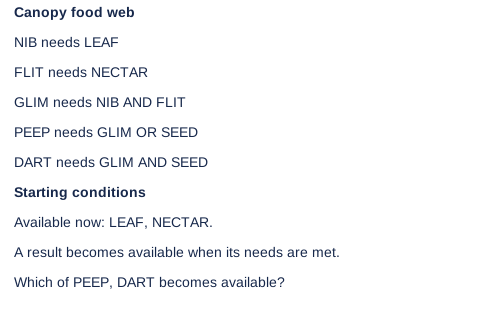
Use only the fictional food-web rules printed here. Start with the food available now. A creature becomes available when its food rule is met. Find which named visitor can live here; a loop cannot create its own first food.
Read this clue in text
Canopy food web
NIB needs LEAF
FLIT needs NECTAR
GLIM needs NIB AND FLIT
PEEP needs GLIM OR SEED
DART needs GLIM AND SEED
Starting conditions
Available now: LEAF, NECTAR.
A result becomes available when its needs are met.
Which of PEEP, DART becomes available?
Clue 2 of 6
Record
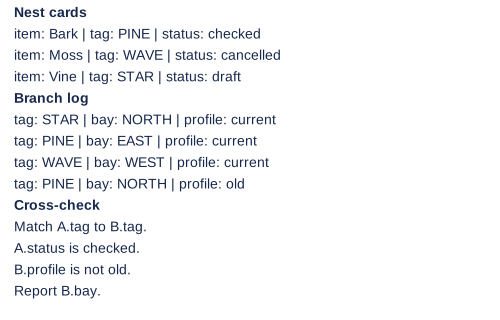
A branch tag was reused when the nest model moved. Keep the checked record and the current branch profile. Follow the matching tag only after rejecting the old profile.
Read this clue in text
Nest cards
item: Bark | tag: PINE | status: checked
item: Moss | tag: WAVE | status: cancelled
item: Vine | tag: STAR | status: draft
Branch log
tag: STAR | bay: NORTH | profile: current
tag: PINE | bay: EAST | profile: current
tag: WAVE | bay: WEST | profile: current
tag: PINE | bay: NORTH | profile: old
Cross-check
Match A.tag to B.tag.
A.status is checked.
B.profile is not old.
Report B.bay.
Clue 3 of 6
Habitat
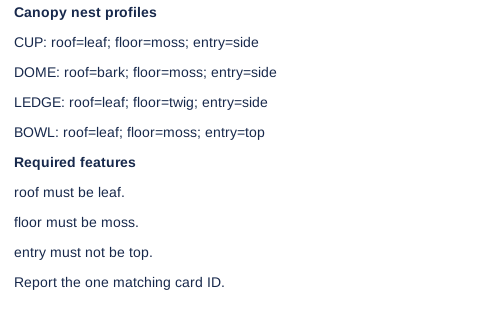
Compare the canopy model profiles with the roof, floor and entry observations. Every observation matters: identify the profile matching all three.
Read this clue in text
Canopy nest profiles
CUP: roof=leaf; floor=moss; entry=side
DOME: roof=bark; floor=moss; entry=side
LEDGE: roof=leaf; floor=twig; entry=side
BOWL: roof=leaf; floor=moss; entry=top
Required features
roof must be leaf.
floor must be moss.
entry must not be top.
Report the one matching card ID.
Clue 4 of 6
Path
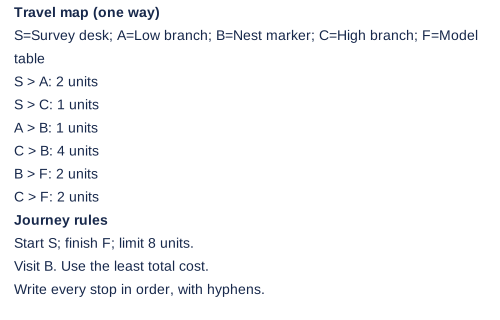
Trace a legal supply journey from S to F. The map's arrows are one-way roads. Visit every required stop, stay inside the travel budget and use the cheapest complete journey. Report all stop letters.
Read this clue in text
Travel map (one way)
S=Survey desk; A=Low branch; B=Nest marker; C=High branch; F=Model table
S > A: 2 units
S > C: 1 units
A > B: 1 units
C > B: 4 units
B > F: 2 units
C > F: 2 units
Journey rules
Start S; finish F; limit 8 units.
Visit B. Use the least total cost.
Write every stop in order, with hyphens.
Clue 5 of 6
Order
Arrange the four event cards using every witness note. "Immediately before" means there is no event between them. Report the requested position after the whole order has been checked.
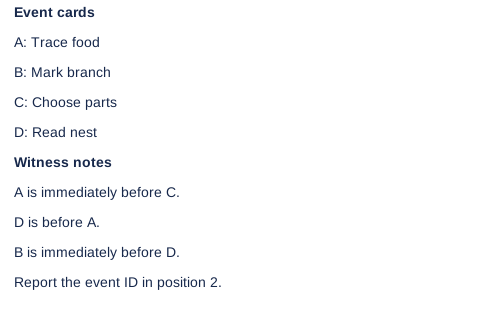
Read this clue in text
Event cards
A: Trace food
B: Mark branch
C: Choose parts
D: Read nest
Witness notes
A is immediately before C.
D is before A.
B is immediately before D.
Report the event ID in position 2.
Clue 6 of 6
Final
Recover one requirement for each habitat layer from its named result. Choose a matching roof, floor, water source, food and entry. Write the five part IDs in the printed layer order, then point to the evidence supporting each choice.
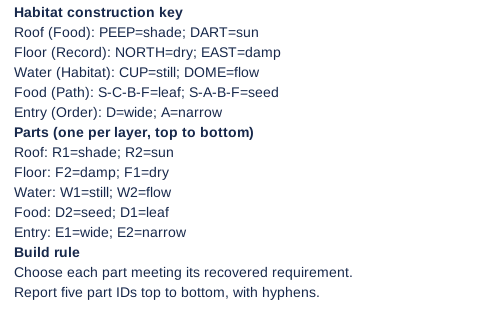
Read this clue in text
Habitat construction key
Roof (Food): PEEP=shade; DART=sun
Floor (Record): NORTH=dry; EAST=damp
Water (Habitat): CUP=still; DOME=flow
Food (Path): S-C-B-F=leaf; S-A-B-F=seed
Entry (Order): D=wide; A=narrow
Parts (one per layer, top to bottom)
Roof: R1=shade; R2=sun
Floor: F2=damp; F1=dry
Water: W1=still; W2=flow
Food: D2=seed; D1=leaf
Entry: E1=wide; E2=narrow
Build rule
Choose each part meeting its recovered requirement.
Report five part IDs top to bottom, with hyphens.
Start after: Food, Record, Habitat, Path, Order
All 9 games in this collection
Connect a habitatAges 8–10 · Est. 35–50 min
The camp needs a shelter design based on its fictional night-creature field cards. Work together to design the camp observation shelter.
6 clues · 2–6 players · No cutting
See clues & prepare → 
Connect a habitatAges 8–10 · Est. 35–50 min
Observers must choose a quiet garden shelter using the night chart and field records. Work together to design the observatory moth shelter.
6 clues · 2–6 players · No cutting
See clues & prepare → 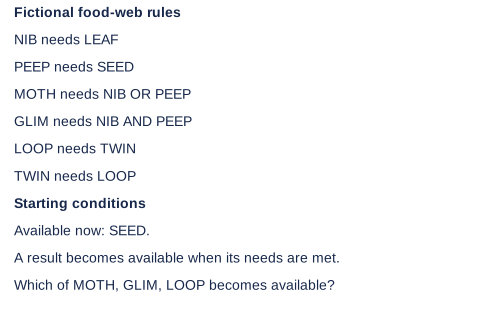
Connect a habitatAges 8–10 · Est. 35–50 min
The planting bed must match the resources and conditions in the greenhouse registry. Work together to build the moon-bean growing bed.
6 clues · 2–6 players · No cutting
See clues & prepare → 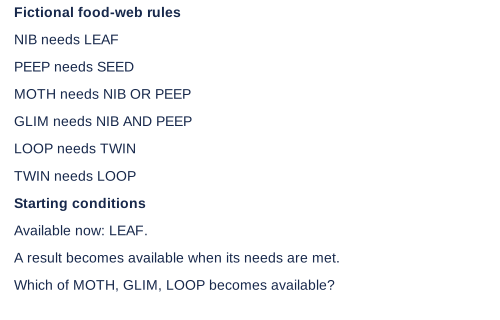
Connect a habitatAges 8–10 · Est. 35–50 min
Fictional track cards describe needs that must be matched to a model habitat. Work together to build a habitat for the track-maker model.
6 clues · 2–6 players · No cutting
See clues & prepare → 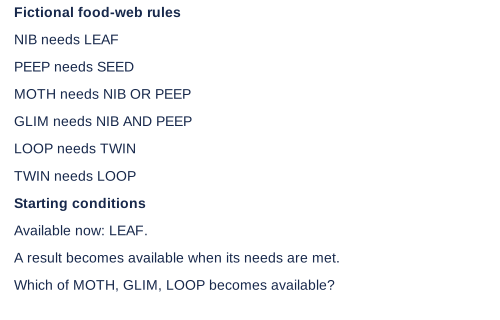
Connect a habitatAges 8–10 · Est. 35–50 min
Supply cards describe a fictional model habitat, and each layer serves a different need. Work together to assemble the model camp shelter.
6 clues · 2–6 players · No cutting
See clues & prepare → 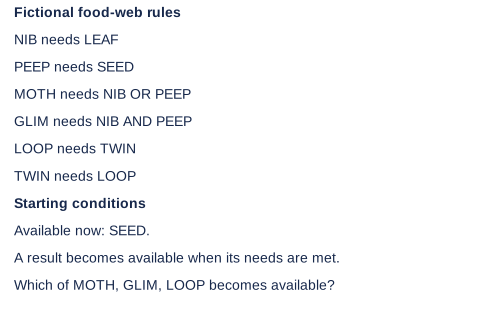
Connect a habitatAges 8–10 · Est. 35–50 min
A nest census must be used to choose a shelter, floor, water source, food and approach. Work together to build the surveyed nest model.
6 clues · 2–6 players · No cutting
See clues & prepare → 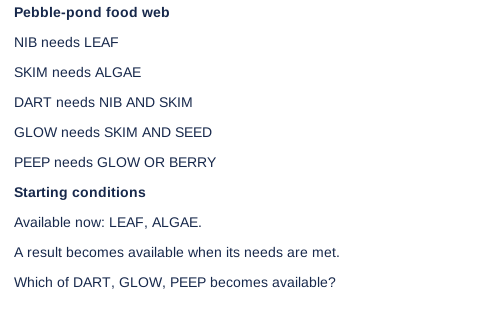
Connect a habitatAges 8–10 · Est. 35–50 min
One pond visitor needs both foods while another can use either, so the food web must be read carefully. Work together to build the pond-neighbor habitat.
6 clues · 2–6 players · No cutting
See clues & prepare → 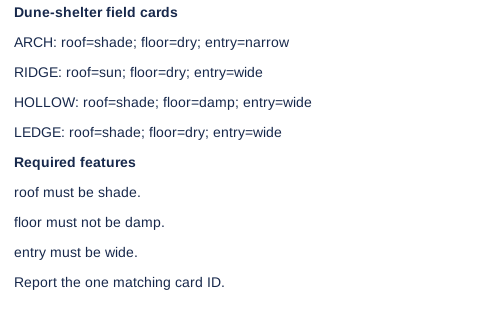
Connect a habitatAges 8–10 · Est. 35–50 min
Shade, dryness and access are separate requirements; a nearly suitable card may fail just one. Work together to design the dune-creature shelter.
6 clues · 2–6 players · No cutting
See clues & prepare → Connect a habitatAges 8–10 · Est. 35–50 min
The nest must match a linked food web and provide five different parts without cutting any paper. Work together to assemble the canopy nest model.
6 clues · 2–6 players · No cutting
See clues & prepare → Try a different reasoning task next
Choose this when your group enjoys noticing differences, explaining a choice and ruling out tempting near matches.
Cross-check evidence →